Producer Perspectives on S. Dublin
“You tested, now what?”: Exploring British Columbian dairy producers' perceptions on Salmonella Dublin management and mitigation
Boyd E, Cuthbert E, Himsworth C, Byers K. 2025. “You tested, now what?”: Exploring British Columbian dairy producers’ perceptions on Salmonella Dublin management and mitigation. One Health https://doi.org/10.1016/j.onehlt.2025.101250
Salmonella Dublin (S. Dublin) is a bacterial disease that affects dairy cattle, causing calf loss, abortions, and reduced milk yield, and is often difficult to control as some animals become chronic carriers. In British Columbia bulk tank milk serology found that 30 % of dairy farms in the province were positive for Salmonella Dublin, which prompted a need for investigation into S. Dublin disease management and mitigation. The objective of this study was to explore BC dairy producers' perceptions and experiences of S. Dublin and how they relate to their actions in S. Dublin management and mitigation, and to leverage this information to inform provincial S. Dublin management programs. Semi-structured interviews were held with 10 BC dairy producers, which were recorded, transcribed and analyzed using the Health Belief Model. Overall, dairy farmers in this study expressed uncertainty surrounding S. Dublin and its management. This uncertainty stemmed from several key sources: 1. Unclear roles and responsibilities regarding disease management among stakeholders, specifically government; 2. Differing views on the necessity of government regulation; 3. Confusion about how information on S. Dublin and disease management is communicated; and 4. Challenges with self-efficacy in the management of S. Dublin. Together, this points towards a need for improved communication and messaging surrounding S. Dublin in BC. Given the perceived value of peer-to-peer communication and narratives, disease messaging may be more effective when coming from sources like producer-led organizations, herd health veterinarians, and “boots on the ground” government officials, as opposed to faceless, top-down government messaging. Ultimately, a deeper understanding of how producers approach S. Dublin management over time and across Canada would strengthen the development of effective strategies for the management of and mitigation of S. Dublin.
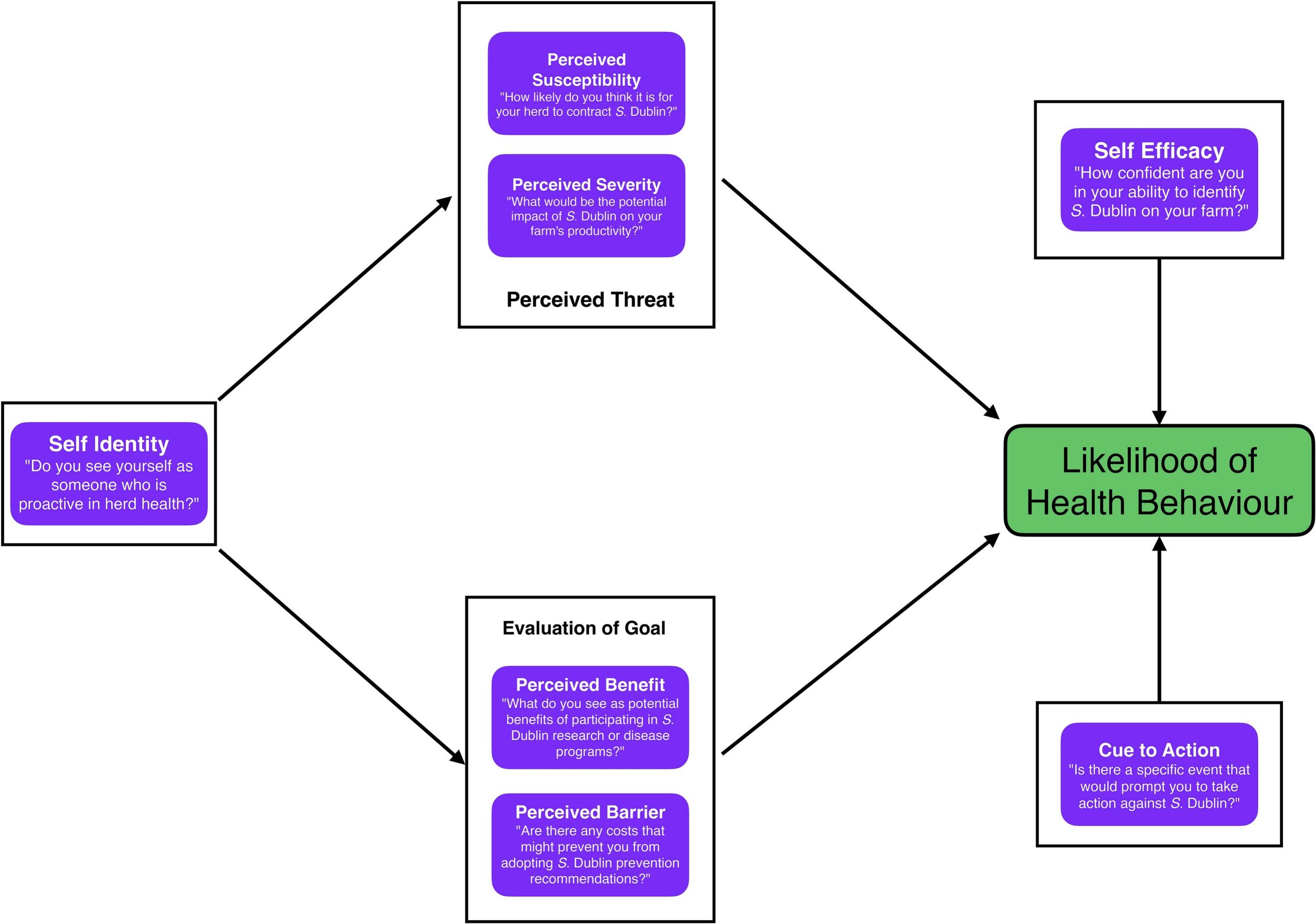
The Health Belief Model explores how key concepts interact to determine the likelihood of a person undertaking a health behavior. Specifically, the model holds that a person's perceived susceptibility and severity explain their perceived threat of an issue and subsequently the motivation to respond to the threat; perceived benefit and perceived barriers determine how one evaluates a goal (preventing disease), and subsequently their willingness to respond; cue to action and self efficacy evaluate an individuals likeliness of responding to a threat, and finally, self identity can function as a modifying factor that influences all other variables. Sample questions that correspond to each concept demonstrate how this can be used to investigate S. Dublin.