Smallholder Perspectives on HPAI Biosecurity
“The trust is gone”: smallholder poultry producers’ perceptions of biosecurity measures against highly pathogenic avian influenza
Andrew C, Tworek H, Himsworth CG, Byers KA. 2026. “The trust is gone”: smallholder poultry producers’ perceptions of biosecurity measures against highly pathogenic avian influenza. BMC Veterinary Research https://doi.org/10.1186/s12917-026-05406-x
Highly pathogenic avian influenza (HPAI) virus has caused recurrent epidemics in wildlife and poultry in North America between 2005 and 2025. British Columbia (B.C.) is located within the Canadian portion of the Pacific Americas Flyway, one of several migratory pathways involved in the global transmission of HPAI to western Canada, which also includes the Yukon, Canada’s northwesternmost territory. HPAI affects both commercial and smallholder poultry production, but little is known about smallholder poultry producers in this region. Biosecurity and communications-focused tools remain among the few available for HPAI prevention in smallholder flocks in Canada. Thus, understanding their perceptions of these topics is crucial for HPAI prevention in this population. We used qualitative research methods (interviews and focus groups) guided by the Health Belief Model (HBM) to explore the perceptions and beliefs of smallholder poultry producers in B.C. and the Yukon, Canada, regarding the prevention of HPAI using biosecurity.
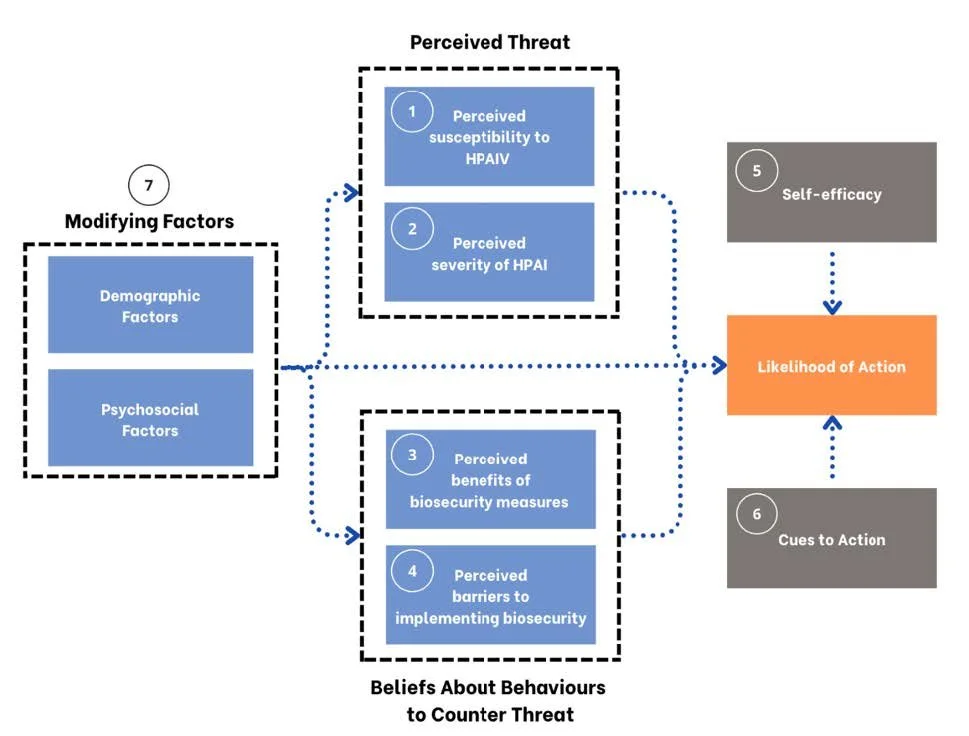
Health Belief Model conceptual framework. Conceptual framework of the Health Belief Model (HBM). Adapted from multiple sources to demonstrate how seven HBM constructs interact to influence health promotion or risk prevention behaviours, including potentially the implementation of biosecurity measures against HPAI among smallholder poultry producers (Gupta et al., 2020; Orji et al., 2012).